
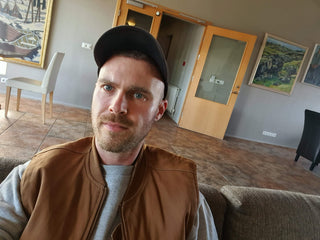

• 37-year-old Ross Berridge opens up about living with scalp psoriasis and the self-care routine that helps keep it under control
• Approximately 1.1 million people in the UK live with psoriasis and Ross shares how the condition made him “extremely self-conscious” in the early days of his diagnosis
• Trichologist Ruth Collis explains the reason behind psoriasis flare-ups and why a coal tar shampoo could help
As conversations around scalp treatment grow and after spending years searching for a way to control the condition himself, Ross Berridge is opening up about the emotional impact psoriasis had on his daily life, and the routine that now helps him manage flare-ups more effectively.
Ross, 37, from Norfolk, says visible symptoms and unpredictable flare-ups left him feeling deeply self-conscious throughout his twenties, particularly while working in a client-facing role. Following lots of trial and error, Ross says a long-term scalp care routine featuring coal tar shampoo, Polytar now helps him keep his psoriasis under control.

According to data from the University of Manchester, around 1.1 million people in the UK are living with psoriasis. The condition causes raised, flaky patches of skin and can affect multiple areas of the body, including the scalp, with research showing that between 50% and 80% of people with psoriasis experience scalp symptoms. Searches for “psoriasis symptoms” have more than doubled (110%) over the last month, reflecting increased awareness and concern around managing the condition.
Ross first experienced the emotional toll of the condition as it spread beyond his scalp into more visible areas.
In the early days of my diagnosis, I was extremely self-conscious of it, and it got progressively worse as my psoriasis spread from my scalp to more visible areas like my forehead, eyebrows, face and beard
Explained Ross.
Over time, I’ve learned to live with it and control it, but I’m conscious that it could flare up at any moment. As I’ve gotten older, it doesn’t bother me as much, but I remember in my early 20s it absolutely did, especially working in a client-facing job.
Ross says the condition particularly affected him during the early stages of his career in recruitment, where appearance and confidence felt closely tied to professional success.
Following my diagnosis, I started a high-pressure career in recruitment
He explained.
In high-pressure, high-stakes commercial environments, every detail counts. When I started to get these aggressive red blotches on my skin, I felt that seeing clients face-to-face would impact my ability to do business.

One moment that particularly stayed with Ross was seeing professional photographs of himself during a psoriasis flare-up.
I remember seeing some photos taken by a wedding photographer where I was a guest, and I was so uncomfortable seeing red patches on my hairline and forehead. “I knew other people would see them too.
Ross also recalls moments where comments from others reinforced his anxiety around visible flare-ups.
I remember once going into work and someone said to me, ‘Are you OK? You look like you’ve been in a fight!’ he said. It was because of a flare-up I had on my cheek, just under my eye, where it genuinely looked like I had the tail end of a black eye.
Like many people living with psoriasis, Ross spent years searching for a solution that would completely clear the condition.
In the early days after being diagnosed, I was looking for one ‘magic pill’ product to try and fix it, he explained. I tried lots of different shampoos, creams and medications to find a solution, and although some things helped, it never completely went away. If something in my life changed, it would usually come back.
Over time, Ross began noticing patterns linked to his flare-ups and started making changes to his lifestyle to better manage the condition.
It wasn’t until I’d been suffering with it for about five years that I started to realise there were triggers for it, things like certain foods and stress levels, he said. I started cutting down on dairy and alcohol and trying to reduce stress where I could. Together, those changes helped reduce flare-ups and made them shorter when they did happen.
Explaining the connection between lifestyle triggers and psoriasis flare-ups, Trichologist Ruth Collis said:
Psoriasis is a complex inflammatory condition that can be influenced by a variety of internal and external triggers. Stress, dietary changes, alcohol consumption and environmental factors can all contribute to increased inflammation within the body, which may lead to flare-ups becoming more frequent or more severe.
What many people experience is a cycle where lifestyle pressures and stress aggravate symptoms, while the visibility and discomfort of psoriasis can then negatively affect confidence and emotional well-being. This is why managing psoriasis often requires a more consistent and long-term approach rather than relying on a single treatment alone.
Despite making lifestyle changes, Ross says he still struggled with persistent scalp irritation and flaking, leading him to introduce specialist shampoos like Polytar into his routine.
It didn’t completely tackle the ongoing flakiness and itchiness on my scalp, which is where I brought in a routine of washing my hair with specialist shampoos like Polytar several times a week, he explained. When I did get flare-ups, I’d also use a steroid cream to calm the aggravation.
Ross also believes hard water may have unknowingly contributed to the severity of his psoriasis symptoms over the years.
I suddenly realised that hard water may be one of the main culprits affecting my scalp, but still didn’t know the science behind it,” he said. “I believe it may have been a significant factor in the condition and severity of my psoriasis over the years.
Trichologist Ruth Collis explains that a combination of scalp irritation and environmental triggers is often behind psoriasis flare-ups: “Hard water can sometimes contribute to scalp dryness and irritation because of the mineral build-up it leaves behind on the scalp and hair. For people already managing inflammatory scalp conditions such as psoriasis, this can sometimes worsen feelings of itchiness, tightness and discomfort.
Maintaining a regular scalp care routine that focuses on reducing irritation and supporting the scalp barrier can make a significant difference over time. Coal tar shampoos remain one of the most established treatment options for scalp psoriasis due to their ability to help slow excessive skin cell production while reducing inflammation and scaling.
Now, after more than a decade of managing the condition, Ross says acceptance has become one of the most important parts of living with psoriasis.

Fifteen years down the line, I now have a routine that generally keeps my psoriasis under control, and it works for me, he said. But largely, it’s the fact that I’ve accepted a life with it. It’s part of me and not something that I’m going to stress about anymore.
Ross now hopes speaking openly about psoriasis may help others struggling with the emotional impact of visible symptoms.
I would say that with determination, perseverance and positivity, you will learn not to let psoriasis control you
Psoriasis is often a vicious cycle, where the impact on your mental health can make it worse. Learning to accept it is the first step. Finding out what triggers it is the second. The third is building a routine that mitigates the triggers and provides a proactive and reactive safety net.
Ross says Polytar has now become a consistent part of the routine he relies on to help keep symptoms under control.
Polytar is a key part of my routine. It isn’t a magic pill, but it’s the backbone of my scalp maintenance that I can’t be without.
Polytar is the original coal tar shampoo, with proven anti-inflammatory, antiseptic, and exfoliating properties. Formulated with a 4% Coal Tar Solution, Polytar is clinically proven to help treat psoriasis as well as other scalp conditions like seborrhoeic dermatitis, eczema, dandruff, flaking, and itching.