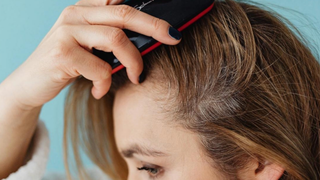
If you’ve ever shrugged off an itchy scalp or brushed a few flakes off your shoulders and got on with your day, you’re far from alone. Our new research shows that more than eight in 10 of us (83%) have experienced a scalp symptom, yet more than half (56%) have ignored or put off dealing with at least one. And while three quarters of us say we’re confident we know what a healthy scalp looks and feels like, the questions we asked suggest there’s plenty we’re getting wrong.
In this blog, we’ll look at what our nationwide survey found about the symptoms we put up with, who’s most likely to ignore them, where we turn for help first, and what you can do to look after your scalp.

How common are scalp symptoms?
Very. Only 15% of the 2,015 UK adults we surveyed said they had never experienced a scalp symptom. The most common were:
- Itching (51%)
- Visible flaking or dandruff (43%)
- Spots or bumps (28%)
- Dryness or tightness (22%)
- Excessive oiliness or greasiness (21%)
- Redness or irritation (20%)
- Tenderness or soreness (17%)
- Burning or stinging (9%)
So, if your scalp has ever played up, you’re in very good company. Scalp symptoms are part of everyday life for most of us, which makes it all the more surprising how often they get brushed aside.
Which scalp symptoms do we ignore?
More than half of Brits (56%) have ignored or put off doing something about at least one scalp symptom. Only 44% said they hadn’t ignored any of the symptoms on our list. Itching is the one we’re most likely to put up with, followed by flaking:
- Itching (23%)
- Visible flaking or dandruff (18%)
- Spots or bumps (15%)
- Dryness or tightness (9%)
- Excessive oiliness or greasiness (9%)
- Tenderness or soreness (7%)
- Redness or irritation (7%)
It’s not hard to see why. An itch comes and goes, a few flakes are easy to hide, and most of us have a longer to-do list than our scalp. But symptoms that keep coming back are worth taking seriously, as they can be a sign your scalp needs some extra care.
Who’s ignoring their scalp the most?
Young adults ignore their scalp the most. Seven in 10 18-24s (70%) and 25-34s (72%) have ignored or put off dealing with at least one symptom, compared with just 36% of over-65s. Three in 10 18-24s (30%) have ignored visible flaking or dandruff, versus 9% of over-65s.
That’s despite younger Brits being the most confident about their scalps. More than a quarter of 18-24s (28%) say they’re very confident they know what a healthy scalp looks and feels like, compared with 10% of over-65s. Yet 16% of 18-24s describe their scalp as unhealthy, against 8% of over-65s, and only one in 10 (10%) say they’ve never had a scalp symptom, compared with a quarter (25%) of over-65s.
Do we know our scalps as well as we think?
Three quarters of Brits (74%) say they’re confident they know what a healthy scalp should look and feel like. But when we tested what people know, a few gaps showed up:
- A quarter (25%) believe that seeing flakes on your scalp always means you have dandruff, and another 16% aren’t sure. That means 41% don’t know that flakes don’t necessarily mean dandruff.
- One in four (25%) don’t know that products like dry shampoo and styling gel can build up on the scalp.
- More than one in five (22%) didn’t correctly identify dandruff as a scalp condition linked to flaking and itching, and 9% think it’s the same thing as a dry scalp.
We also asked which everyday things can affect scalp health. Here’s how many people recognised each one:
- Products sitting on the scalp (72%)
- Stress (71%)
- Sweating and exercise (58%)
- Hard water (44%)
- Winter weather (44%)
That means more than half of us (56%) don’t realise that hard water or winter weather can have an impact on our scalps. Women did better than men on some of the questions, with 81% of women correctly identifying what dandruff is, compared with 74% of men, and 81% of women knowing that products can contribute to build-up, versus 69% of men.

Flakes aren’t always dandruff
Flakes can be a sign of dandruff, but they can also be down to a dry scalp, product build-up, or a skin condition such as seborrhoeic dermatitis, eczema or psoriasis. They can look similar, which is why a flaky scalp that doesn’t settle down is worth getting checked rather than guessed at.
Where do we turn first?
When we asked people where they’d go first after noticing a new scalp concern, the most popular answer wasn’t a health professional. One in five (21%) said they’d turn to Google or another search engine, ahead of their GP (17%) and their pharmacist (16%). The full list looks like this:
-
Google or a search engine (21%)
-
GP (17%)
-
Pharmacist (16%)
-
Friends or family (9%)
-
Hairdresser or barber (8%)
-
Dermatologist (6%)
-
AI tool or chatbot (5%)
-
TikTok (3%)
Among 18-24s, TikTok (9%) is almost as popular a first stop as the GP (9%), and 8% would ask an AI tool first, which is as many as would go to their pharmacist.
A quick search can be a useful place to start, but it can’t see your scalp. If something is itchy, sore or flaky and it’s not getting better, a pharmacist or GP can look at what’s going on and point you in the right direction.
Out of sight, out of mind?
Part of the reason the scalp gets forgotten may be that we simply don’t look at it very often. We asked people how often they check different parts of their body. Among those who do, the averages came out as:
- Teeth: every 5.5 days
- Facial skin: every 6.1 days
- Hair: every 8.6 days
- Feet: every 12.0 days
- Scalp: every 12.9 days
That’s roughly twice as often for our face as our scalp. One in eight of us (13%) never deliberately check our scalp at all, compared with 5% who never check their face and 8% who never check their feet. Add up the time we say we spend checking ten areas of the body, from face and teeth to feet and belly button, and it comes to almost 90 hours a year. The scalp gets just over nine of them.
What to do about scalp symptoms
You don’t need to overhaul your routine to look after your scalp. A few simple habits can help.
Polytar Trichologist Marta Teixeira, a Prescribing Clinical Trichologist at CliniHair, NHS Dermatology Specialist Nurse & Lecturer & Academic Tutor in Trichology, says:
"My advice is simple: check your scalp as often as you check your face, in good light and don't ignore itching, flaking or soreness. A pharmacist can recommend a medicated shampoo with an evidence-based ingredient such as coal tar. If things haven't improved after four weeks or your scalp is red, swollen or painful, see your GP, a dermatologist or a qualified trichologist."
For those experiencing dandruff, flaking, or inflammatory scalp conditions, products containing coal tar can help calm irritation and restore balance. Coal tar has been used for decades thanks to its anti-inflammatory and antiseptic properties.

Polytar is a coal tar shampoo designed to help manage scalp conditions such as psoriasis, seborrhoeic dermatitis, eczema, dandruff, flaking, and itching. If your scalp has been giving you grief, adding Polytar to your weekly haircare routine may help soothe and rebalance it.
Want to find out how healthy your scalp is? Try our Scalp Health Calculator, which looks at everyday factors like stress, exercise, winter weather, hard water and product build-up.
Methodology
Polytar research conducted by Obsurvant among 2,015 UK adults aged 18+ on 5-6 October 2026, nationally representative by age, gender and region. Frequency averages exclude “never” and “not sure” responses; time averages exclude “don’t know”. The annual figure is calculated from average weekly time spent checking each of the ten areas, multiplied by 52, and is an estimate based on respondents’ own answers.