
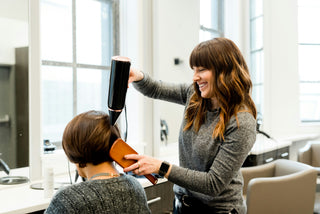
If you’ve ever mentioned an itchy scalp, dandruff, or hair concerns while sitting in the salon chair, you're probably not the only one. Our latest research shows that women across the UK are increasingly turning to hairdressers rather than their GP for advice about scalp and hair issues.
With NHS waiting lists continuing to rise and ongoing challenges around accessing appointments, the salon is becoming an important space for informal health conversations. For many women, the hair salon offers a more accessible and comfortable place to raise concerns that might otherwise go unspoken.
In this blog, we explore what our findings reveal about women’s health behaviours, why hairdressers are trusted voices, and what this means for managing common scalp conditions.
Why women are turning to their hairdressers
According to the British Medical Association, the NHS waiting list currently stands at 7.29 million cases, with over six million patients waiting for treatment.
Against this backdrop, our research highlights several barriers preventing women from seeking medical advice:
• Nearly half of women (44%) say difficulty booking a GP appointment has put them off
• Nearly a third (32%) cite long NHS waiting times
• Over a third (38%) don’t consider their issue serious enough
• Over a quarter (27%) worry about wasting their doctor’s time
• Around one in six (17%) prefer to manage concerns themselves
As a result, many women have no choice but to seek advice elsewhere.More than half of women (52%) say they have asked a hairdresser for advice about scalp or hair concerns. In fact, women are now just as likely to turn to a hairdresser (23%) as they are to a GP (23%) for support with these issues, highlighting a shift in where early advice is sought.
What women are asking about in the salon
Scalp concerns are common and wide-ranging for women. Our research shows that almost two-thirds (74%) of women have experienced a scalp condition. Almost half of women (49%) have dealt with dandruff, and the same number have experienced itchiness on their scalp.
These conditions are often linked to inflammation and changes in the skin’s natural cycle, and they can have both physical and emotional effects. Our cycle flakes report also shows that hormones may have an impact on the scalp as well.
Stress also plays a significant role, with over half of women (57%) saying they notice negative changes in their scalp during stressful periods.
Despite how common these concerns are, they are not always discussed in clinical settings. Instead, the salon is the place where these conversations happen more naturally.
Why are hairdressers becoming trusted voices?
Trichologist Ruth Collis explains:
“Hairdressers often build long-standing relationships with their clients, seeing them every few weeks and having open, informal conversations in a setting that feels familiar and low-pressure. Because they work directly on the scalp and hair at close range, they are frequently the first to notice visible concerns such as flaking, redness, or irritation. For many women, it can feel easier to mention something in that environment rather than deal with the hassle of booking a GP appointment for what they might perceive to be a minor issue.”
The salon environment offers:
• a relaxed, non-clinical setting
• regular, face-to-face interaction
• strong relationships and trust
• a safe space for open, personal conversations
Nearly a quarter of women (21%) say embarrassment has delayed them speaking to a doctor, and by contrast, almost two-thirds (63%) say they talk to their hairdresser about topics beyond just their hair.
A generational shift in where advice is sought
Younger women are more open with hairdressers than older women.Over four in five (84%) of women aged 18–24 say they speak to their hairdresser about personal topics beyond hair, compared to 53% of women aged 65 or over.
The comfort felt in the hair salon also means that some women ask for advice about minor health issues like scalp conditions. Our research shows that over a quarter (28%) of women aged 18–34 would speak to a hairdresser first about a new scalp concern.
However, while hairdressers can help flag visible issues, they are not a replacement for medical advice where needed, particularly for persistent or severe symptoms.
How can Polytar help with common scalp conditions women experience?
Conditions such as dandruff, psoriasis, eczema, and seborrhoeic dermatitis are often driven by inflammation and disruptions in normal skin cell turnover. Left unmanaged, they can worsen over time and impact both comfort and confidence.
Polytar, formulated with 4% Coal Tar solution, is designed to treat persistent dandruff, psoriasis, eczema, and itchy scalps by addressing the underlying cause rather than simply masking symptoms. With proven anti-inflammatory, antiseptic, and exfoliating properties, it works to calm irritation, reduce scaling, and support a healthier scalp environment.
Used as part of a consistent haircare routine, treatments like Polytar can offer an accessible first step for managing ongoing scalp concerns.
A changing landscape for women’s health conversations
Our findings highlight a clear shift in how and where women are seeking advice for scalp and hair concerns. While GPs remain an important and trusted source of medical support, the salon is increasingly becoming a first point of contact, particularly for visible or early-stage issues.
For many women, the salon feels more approachable, less intimidating, and easier to access than traditional healthcare settings where barriers still persist.
Wherever you choose to seek advice, consider incorporating Polytar into your routine if you’re experiencing scalp conditions such as dandruff, psoriasis, eczema, seborrhoeic dermatitis, flaking, or itching.
Methodology
Polytar Barbers & Hairdresser Report 2026 (n=2,000 nationally representative adults)
Polytar Stress Research 2026 (n=2,000 nationally representative adults)