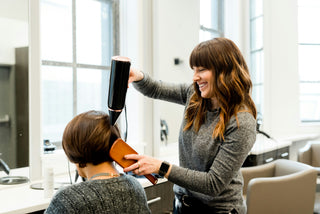

Ever wondered what hairdressers hear in the salon chair? We sat down with two hairdressers, and they revealed the most common things they hear clients admit to in the salon chair. From skipping wash days, sleeping with wet hair, overusing dry shampoo, to ignoring their scalp health altogether.
For many, the hair salon is more than just a place for a cut or colour. It’s a space where honest conversations happen, including sharing the habits we know we probably shouldn’t be doing. From neglected routines to common misconceptions, it turns out hairdressers hear it all.
In this blog, we explore the most common bad habits clients confess to in the salon, what professionals are noticing, and what can be done to promote long-term scalp health.
Across salons, certain patterns come up time and time again. “It’s very common for clients to ask about their hair and scalp, especially if they’ve noticed changes. Hairdressers are often the first point of call for scalp problems, as we are regularly assessing the hair and scalp during appointments and can spot concerns early on.” Hairdresser and Polytar Trichologist, Amy Hunt, said.
But while clients are seeking expert advice, they’re also revealing their biggest hair and scalp care confessions. Drawing on her experience in the salon, Amy shares the top five myths and habits clients admit to, along with why they could be doing more harm than good.
The most common hair and scalp bad habits and confessions
“I go to bed with wet hair.”
Amy says, “Sleeping with wet hair creates a warm, damp environment on the scalp, which can encourage microbial imbalance and overgrowth of yeasts such as Malassezia, often linked to dandruff and irritation. If someone already has an inflammatory scalp condition, this can worsen symptoms.”
“I’ve used dry shampoo for days instead of washing my hair.”
Amy says, “Dry shampoo can be useful occasionally, but relying on it instead of cleansing the scalp can lead to product build-up, blocked follicles and irritation. It absorbs oil temporarily, but it doesn’t remove sweat, dead skin cells or debris from the scalp.”
“I wash my hair every day because it feels greasy.”
Amy says, “Over-washing can strip away the scalp’s natural oils, which are important for maintaining the skin barrier and supporting a healthy microbiome. This can leave the scalp feeling dry, irritated and sometimes trigger rebound oiliness.”
“I use a detox shampoo every wash.”
Amy says, “Clarifying or detox shampoos are helpful for removing heavy build-up, but using them too frequently can be harsh on the scalp. They are often stronger cleansing formulas, which may disrupt the skin barrier and lead to dryness or sensitivity over time.”
“I scratch my scalp with a comb or my nails.”
Amy says - “Repeated scratching can damage the scalp surface, increase inflammation, and raise the risk of infection. It may also worsen conditions such as eczema, dandruff, or psoriasis by further irritating already compromised skin.”
What else are hairdressers noticing in the chair?
Beyond these common confessions, we found that hairdressers are also seeing a wider gap in how people approach scalp care compared to hair care. Our findings show that most people’s habits are rooted in convenience, misinformation, or simply not knowing what’s best for their scalp.
To find out more, we spoke to Andree Marie, owner of Maison Style salon, about what she hears the most and what people can do to prioritise their scalp health more.
Andree Marie notices that scalp health is often overlooked entirely until visible symptoms appear. She advises her clients to take care of their bodies from the inside.
“Scalp care is just as important as hair care, because that's where your hair comes from. Just like your skin, you have to look after your scalp. I think a lot of people try to look after their hair, and they don't care about the scalp,” she said.
We found many of the confessions hairdressers hear come down to an imbalance, either doing too much or not enough.
“One myth I wish would disappear is that washing your hair less makes it grow faster. Hair growth happens at the follicle level, so skipping washes doesn’t stimulate growth; it can actually lead to buildup on the scalp,” explained Andree Marie.
Instead, Andree suggests that maintaining a clean and balanced scalp is key: “Once you get into the routine of washing your hair often, your scalp will be better, your hair will be hydrated, creating a great environment for your hair to grow.”
Hairdressers are also increasingly linking scalp concerns to lifestyle factors such as stress, diet, and overall well-being.
“I always say to my clients, if you don't look after yourself and inside, that's drinking water, taking your vitamins, how could you possibly have a great scalp? Look after yourself on the inside, and it will come out on the outside,” she said.
Andree Marie also spots over-oiling often, too. “The number one thing I see clients do, which is a massive mistake, is apply oil to their scalp. It’s very common, but I always tell my clients to wash their hair with a scalp shampoo.”
The influence of online trends
Amy has noticed more and more clients coming in after trying things they have seen online. “I’ve definitely seen an increase in clients trying extreme or viral trends they’ve seen online. One that comes up quite often is people applying onion juice to their scalp in the hope of stimulating hair growth. While the intention is there, it can be very irritating to the scalp and may disrupt the skin barrier, particularly for those with sensitive or inflamed skin.
“I’ve also had clients try things like apple cider vinegar rinses, believing it will “detox” the scalp. While there are apple cider vinegar-based products available on the market, these are carefully formulated and regulated to be safe for the skin. Using raw or DIY versions at home can disrupt the scalp’s natural pH, leading to dryness, irritation and increased sensitivity if not used appropriately.
“Another growing trend is the overuse of DIY masks left on overnight, which can suffocate the scalp environment and contribute to build-up or flare-ups of conditions like dandruff.
“What’s most concerning is that many of these trends are well-intentioned but not tailored to the individual. The scalp is a delicate environment, and using unregulated or harsh ingredients can often do more harm than good, especially without understanding the underlying cause of the issue.”
A shift towards scalp-first haircare
What these confessions reveal is a broader shift in how people are thinking about hair health. With more open conversations happening in the salon chair, hairdressers are becoming an important source of guidance, helping clients move beyond quick fixes and towards more balanced, informed routines. As awareness continues to grow, one thing is clear: taking care of your scalp isn’t just an afterthought; it’s the foundation of healthy hair.
For those looking to build their haircare routine, Polytar can be used once or twice a week. Formulated with 4% Coal Tar solution, it has proven anti-inflammatory, antiseptic, and exfoliating properties, which work to calm irritation, reduce scaling, and support a healthier scalp environment.
Methodology
Polytar Barbers & Hairdresser Report 2026 (n=2,000 nationally representative adults)
Polytar Stress on the Scalp Report 2026 (n=2,000 nationally representative adults)